


Everything You Need to Know About Facelifts - Part 2 - Beauty and the Surgeon Episode 156
For more information, check out our podcast, Beauty and the Surgeon. Episodes 155 and 156 cover everything you need to know about facelifts.
Most people spend hours researching facelift techniques and before-and-after photos… and about 30 seconds thinking about recovery. The truth? Your recovery is more than half the journey—and you’ll enjoy your results a lot more if you’re prepared for what happens after you leave the operating room.
As facelift surgeons, we can do amazing work in the OR. But once you’re rolled out of the operating room, it’s your turn (and your caregiver’s) to carry the baton. Let’s talk about how to prepare so recovery feels organized instead of chaotic.
Step One: Read Your Post-Op Instructions (For Real)
This sounds obvious, but it’s the step people skip the most.
You’ll get detailed postoperative instructions from our office, and they’re not just legal paperwork—they’re your survival guide. You and your primary caregiver should:
-
Read them before surgery
-
Highlight or note anything confusing
-
Bring questions to your pre-op visit or call us
We love your questions, but 90% of the “Is this normal?” texts we get are already answered in that packet. When both you and your caregiver know what to expect, the anxiety level drops dramatically.
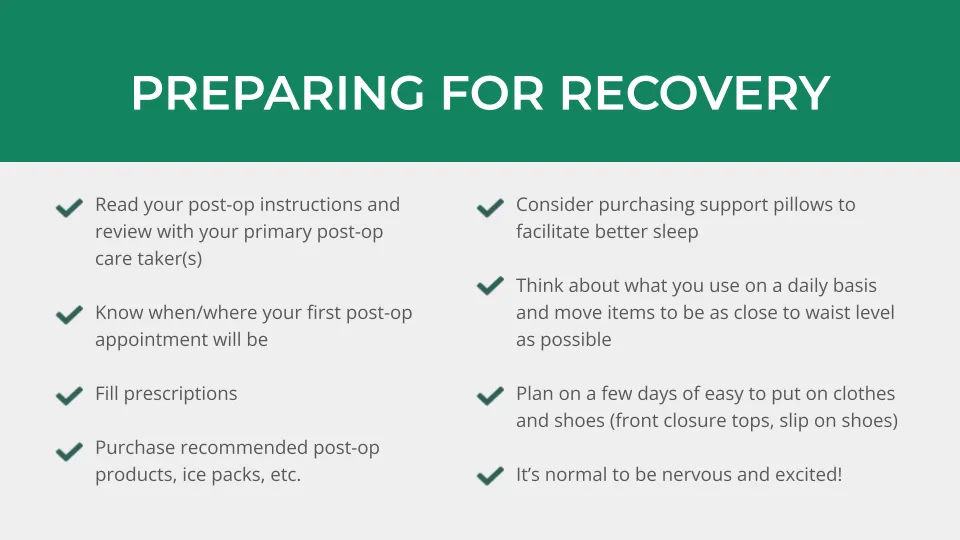
Step Two: Loop In Your Caregiver
Whoever is helping you after surgery—spouse, partner, friend, adult child—needs to be part of the plan, not surprised by it.
Have them:
-
Review the post-op instructions
-
Know what medications you’ll be taking and when
-
Understand what’s normal (swelling, bruising, tightness) and what isn’t
Taking care of someone after surgery can feel stressful if you don’t know what’s coming. A caregiver who’s informed is calmer, more confident, and much better able to support you.
Step Three: Handle Prescriptions Before Surgery Day
One of the most avoidable stressors after facelift surgery: realizing your prescriptions haven’t been picked up.
We strongly recommend:
-
*Fill all prescriptions before surgery day*
-
Keep them together in a basket near your bed or recovery area
-
Use a simple schedule or pill box if you like structure
You don’t want your first car ride after surgery to be a pharmacy dash.
Step Four: Create a “Recovery Nest”
Facelift recovery is not the time to be climbing into a high bed, wrestling with a low couch, or rolling out of a hammock (please don’t do that).
Think about:
-
Where you’ll sleep for the first week or two
-
A bed that’s easy to get in and out of
-
Extra pillows or a wedge system to keep your head elevated
-
-
*What you’ll need within arm’s reach*
- Water, snacks, phone charger, lip balm, tissues, remote, meds
We often recommend a pillow or wedge system that keeps you slightly elevated and supported. Your neck and face will thank you.
Step Five: Move Your Stuff to Waist Level
After a facelift, bending forward so your head drops below your heart is uncomfortable and can increase swelling and throbbing.
A week or so before surgery:
-
Move daily-use items (toiletries, makeup, dishes, pet supplies) from low cabinets or drawers *up to waist or counter height*
-
If there are things you usually keep on high shelves that require neck extension, consider bringing those down too
You want to minimize repeated bending and reaching. Think “T-Rex arms”: everything you need should be grab-able without a yoga move.
Step Six: Dress for Success (and Sanity)
Clothing matters more than you’d think.
Right after a facelift, you’ll want:
-
Front-closing tops — zip-ups, button-downs, wraps
-
No tight turtlenecks or high-neck sweaters you have to drag over your ears
-
Slip-on shoes — no bending over to tie laces
We’ve seen what happens when someone forgets this and yanks a thick sweater off over fresh incisions around the ears. It’s… memorable. For at least two weeks, think: zip, snap, or button in the front and shoes you can step into.
Step Seven: Expect Nerves (and Excitement)
It’s completely normal to feel:
-
Nervous before surgery
-
Impatient a few days after surgery (“Why am I not healed yet?”)
-
Excited to see the final result *yesterday*
Recovery is a process, not a single moment. There will be swelling, there will be a few “What did I do?” days, and then—gradually—you’ll start seeing the new jawline, smoother neck, and refreshed lower face emerge.
Our job is to guide you through each phase so nothing catches you off guard.
Your Next Step
Preparing well for facelift recovery is one of the best gifts you can give your future self. A little planning now means fewer surprises, less stress, and a smoother path to enjoying your results.
If you’re considering a facelift and want to know precisely what recovery would look like for you, we’d be happy to walk you through it. Schedule a consultation with our office, and we’ll review your anatomy, your health, your lifestyle—and build a facelift and recovery plan that fits your real life, not just the brochure version.