FaceTite
For early to moderate loose skin in your lower face and neck.
FaceTite gives you a quick recovery with no surgical scars. It does less when you have heavy, loose skin.


Face
Tighten your lower face, jawline, and neck without the incisions or downtime of a facelift.
FaceTite RF Skin Tightening
FaceTite isn't a facelift. It's what many patients choose before they need one. When your lower face and neck start to soften, FaceTite uses radiofrequency energy beneath your skin, through a tiny entry point, to firm your jawline and tighten loose skin. Most patients are back to light activity within a few days.
In our practice, Dr. Jason Martin has worked with radiofrequency contouring since its early days, and he teaches other physicians how to use it.
At a Glance
These are the typical starting points for FaceTite. Your consultation with Dr. Martin will define the approach that's right for you.
(depends on the areas we treat)
(performed in our office)
(a supportive garment is worn for a short time)
(your result keeps improving over 3 to 6 months)
(your face keeps aging naturally)
(one or two tiny entry points)
(depends on your areas and whether we add AccuTite)

The procedure
FaceTite uses a technique called radiofrequency-assisted lipolysis (RFAL). A thin probe slides under your skin through a small entry point while an electrode rests on the surface. Energy passes between them and heats the underside of your skin while the device tracks the temperature in real time.
That heat tightens your skin without cutting any away, and it can loosen small pockets of fat under your jaw and chin so we can gently remove them. Your body then builds new collagen, so your FaceTite result keeps improving for months.
Your options
The right treatment depends on how far your lower face has changed, and Dr. Martin will tell you which fits you.
For early to moderate loose skin in your lower face and neck.
FaceTite gives you a quick recovery with no surgical scars. It does less when you have heavy, loose skin.
For more advanced aging in your face and neck.
A facelift and neck lift repositions the deeper layers of your face and removes extra skin, with a longer recovery and incisions hidden around your ears.
Treatment areas
FaceTite focuses on the lower third of your face and your neck. For the area around your eyes, we often pair it with AccuTite.
firms softening skin across your lower face
tightens the skin that gathers along your jawline
brings back a cleaner, sharper contour
tightens loose skin and reduces fullness under your chin
Candidacy
FaceTite is a good fit for healthy adults who are noticing early changes in their lower face and neck, generally from their late 30s through their 50s.
You may be a good candidate if you:
FaceTite tightens the skin you have, so it works best for mild to moderate laxity. Significant loose skin, deep folds, or a heavy neck call for a facelift, and Dr. Martin will tell you so.

Experience & judgment
Dr. Martin has worked with radiofrequency contouring since its early days, and he teaches other physicians how to use these technologies. Because he performs both FaceTite and facelifts, he recommends the one your face needs.
What he brings to his work


The procedure, step by step
FaceTite is usually performed in our office under local anesthesia, often with light sedation, and it typically takes about 60 to 90 minutes. While every treatment is personalized, the process follows four key steps.
We numb the area and make one or two tiny entry points.
The probe delivers radiofrequency energy beneath your skin while we monitor the temperature in real time.
When your plan includes your jowls or neck, we gently remove loosened fat through the same openings.
We place a supportive garment around your chin and neck.
Recovery
FaceTite recovery is much lighter than a facelift. Here's what most patients can expect.
The First Day or Two
Take it easy while the treated areas settle.
Within a Few Days
Most patients return to light activity.
The First One to Two Weeks
You'll wear your supportive garment for a short time. Some swelling and bruising are normal and fade over these weeks.
Three to Six Months
Your skin keeps tightening as new collagen forms, and your final result develops.
Risks
Knowing what to expect is part of making a confident decision. Like any procedure, FaceTite carries risks, including swelling, bruising, temporary numbness, firmness under the skin, and, rarely, burns.
During your consultation, we'll review your individual risks and how we plan your treatment and recovery to reduce them.
Proof


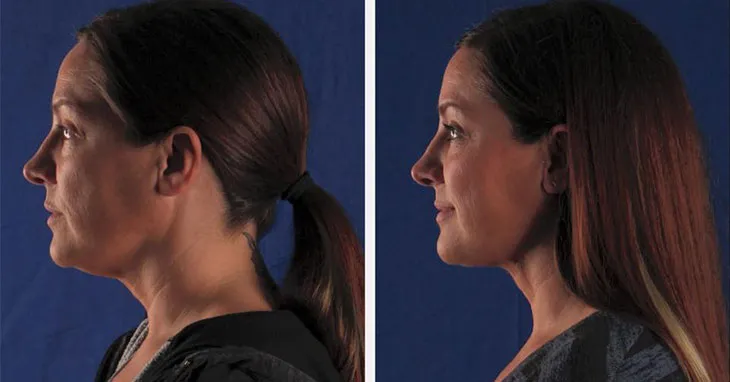
Results vary from patient to patient. Photographs are of Dr. Martin's actual patients, shown with their consent.
Investment
FaceTite in Denver generally costs between $4,000 and $8,000. Your price depends on the areas we treat and whether we combine FaceTite with AccuTite, and anesthesia and facility fees are part of the total.
We believe pricing should be as personalized and transparent as your care. At your consultation, we'll review your options, provide an itemized quote, and discuss payment options so you can plan comfortably and confidently.
Patient experience
Dr. Martin's patients consistently describe facial tightening that looks natural and a recovery that was easier than they expected.
Beauty & the Surgeon
Dr. Martin covers skin tightening and facial rejuvenation on his podcast, Beauty and the Surgeon. These episodes are a good place to start.
Common questions
FaceTite typically costs between $4,000 and $8,000 in our Denver practice, depending on your areas and whether we add AccuTite. Anesthesia and facility fees are part of your quote. At your consultation, we'll give you an itemized quote and review payment options with you.
FaceTite results last several years for most patients and hold up best with a stable weight. Your face keeps aging, so many patients refresh their result after a few years.
Neither is better in every case. FaceTite fits early to moderate laxity, and a facelift fits heavy, loose skin and deeper tissue that has descended.
Yes. Your jowls and jawline are among the areas FaceTite treats best. Very heavy jowls with a lot of loose skin do better with a facelift.
Yes. Heat makes your existing collagen contract and prompts new collagen over the following months, so your result is most visible a few months after treatment.
Expect some swelling and bruising, a supportive garment early in recovery, and a result that builds slowly. FaceTite also does less than a facelift for advanced laxity.
FaceTite can delay a facelift, sometimes for years, but it can't do what a facelift does once the deeper tissue of your face has descended.
Beyond FaceTite
FaceTite is one way to refresh your face. Explore these related procedures to discover more options.
From Dr. Martin's desk
Wondering whether FaceTite or a facelift fits you better? Explore Dr. Martin's articles for helpful answers, practical advice, and a closer look at natural-looking results.

Begin
You deserve more than a one-size-fits-all approach to your face. Your consultation with Dr. Martin is the best way to find out whether FaceTite or a facelift fits your goals. We offer virtual consultations, or you can visit us in person. Ready to take the next step? Call (303) 321-1439 and let's create something beautiful together.
(303) 321-1439