


Listener Questions and Comments - Part 2- Beauty and the Surgeon Episode 190
For more information, check out our podcast, Beauty and the Surgeon. Episodes 155 and 156 cover everything you need to know about facelifts.
Let’s talk about the part no one likes to post on social media: facelift recovery.
Surgery day gets all the attention, but how you plan and move through the healing process has a huge impact on how quickly you look (and feel) like yourself again. Our goal here is to give you a clear, honest, and slightly witty roadmap so you know what to expect after a facelift—and how to set yourself up for the best, most natural-looking results.
The First 24–48 Hours: Rest, Support, and Netflix
Right after surgery, your full-time job is rest and recovery, not multitasking.
Most patients go home the same day with a responsible adult, or spend a night in a monitored setting if that’s part of the plan. You’ll likely feel groggy, tight, and a little puffy—that’s normal. This is not the time to check work emails or reorganize your closet.
*Showers:* In most cases, patients can shower within 24–48 hours after a facelift. We’ll give you specific instructions about how to protect your incisions, when to wash your hair, and what to avoid. (Spoiler: high-pressure scalding showers are not part of the program.) Clean and gentle is the vibe.
*Help at home:* We strongly recommend arranging help for the first 48–72 hours. That might mean a partner, a friend, a family member, or a hired caregiver. Their job is to help with things like meals, medication reminders, and basic household tasks so you can focus on healing—not on lifting laundry baskets.
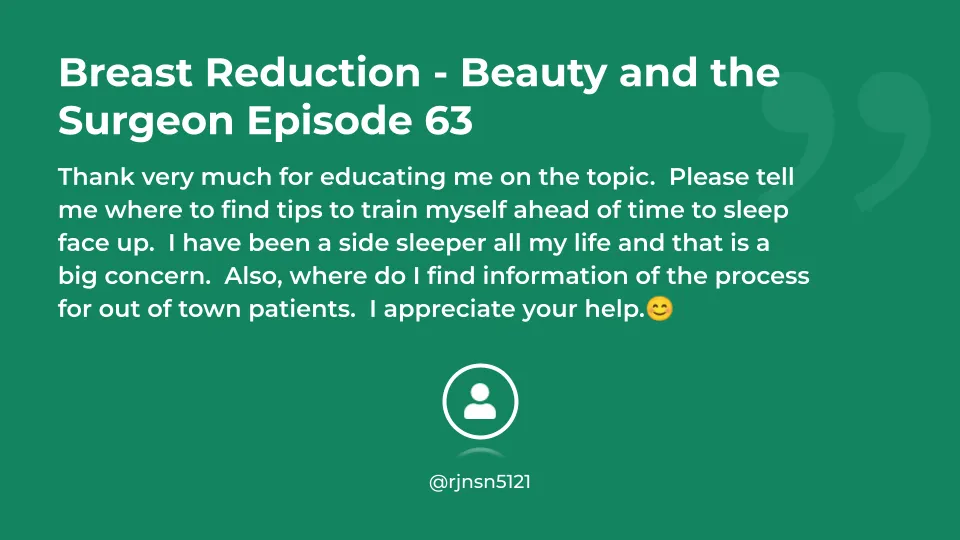
*Sleeping:* As with many of our surgeries (see breast reduction below), we recommend sleeping on your back with your head elevated for at least 1–2 weeks after a facelift—think “royal reclining” with extra pillows—to protect your results, reduce swelling, and avoid accidentally squishing your fresh lift, especially your ears.
Swelling, Bruising, and the “Is This Normal?” Phase
Even with a beautifully performed facelift, swelling and bruising are normal — they’re part of the healing story.
-
Expect visible swelling and bruising for the first week.
-
Most “social swelling” (the kind that would make you hesitate to go to dinner or be in photos) improves significantly by 2 weeks.
-
Subtle refinement—tightening, softening, and settling—continues quietly in the background for 4 weeks.
Think of it as your face going through a series of drafts before landing on the final version. We’ll see you for follow-up visits, assess your progress, and reassure you about what’s normal at each stage.
Activity: When Can You Get Back to Real Life?
We want you up and walking lightly right away to promote circulation, but this is not the time to test your personal records.
Here’s the general idea (your specific plan may vary):
-
First week: Lots of rest, short and longer walks, no heavy lifting, no bending over like you’re hunting for something under the couch.
-
First two weeks: Plan for a window of limited activity. You may feel okay, but your tissues are still healing. We want minimal strain, no intense workouts, and no activities that significantly raise your heart rate or blood pressure.
-
After two weeks: Many patients are comfortable returning to some social outings and light errands—often with a bit of makeup and a good hairstyle.
More vigorous exercise, heavy lifting, and high-impact activities are usually postponed longer; we’ll give you a personalized timeline so you don’t have to guess.
Planning Makes Recovery Feel (Almost) Easy
Here’s where the magic really is: thoughtful recovery planning.
Before surgery, we’ll walk you through:
-
Medications you’ll be prescribed and when to start them
-
What to have ready at home (pillows, ice packs, easy meals, entertainment)
-
When you can shower, wash your hair, and use skincare or makeup
-
When you can drive, work, travel, and exercise
We also give you written checklists so you’re not trying to remember everything while groggy. And yes, we absolutely talk about details like when you can color your hair—because feeling like yourself again includes looking like yourself again.
The Bottom Line
Facelift recovery isn’t about hiding out for months; it’s about respecting the healing process so your natural results are maintained and they are long-lasting.
With thoughtful planning, a little help at home, and realistic expectations about swelling, bruising, and activity, you can move through recovery confidently and safely—and get to the fun part faster: enjoying your refreshed, natural-looking facelift results.
Things to remember about recovery from a facelift
If you’re considering a facelift and want to understand the full journey, not just the “before and after,” we’d be happy to walk you through it step by step in a consultation.