


Everything You Need to Know About Facelifts - Part 1 - Beauty and the Surgeon Episode 155For more information, check out our podcast, Beauty and the Surgeon. Episodes 155 and 156 cover everything you need to know about facelifts.
If you’ve spent any time on the internet looking into facelifts, you’ve probably seen the buzzwords: “deep plane,” “SMASectomy,” “mini facelift,” “ponytail lift,” and so on. Marketing loves fancy labels. Medicine loves long and confusing names. In real life, it’s less about the name and more about whether the technique matches your anatomy and, most importantly, your goals. Check out this guide for a concise breakdown of the facelift techniques we offer.
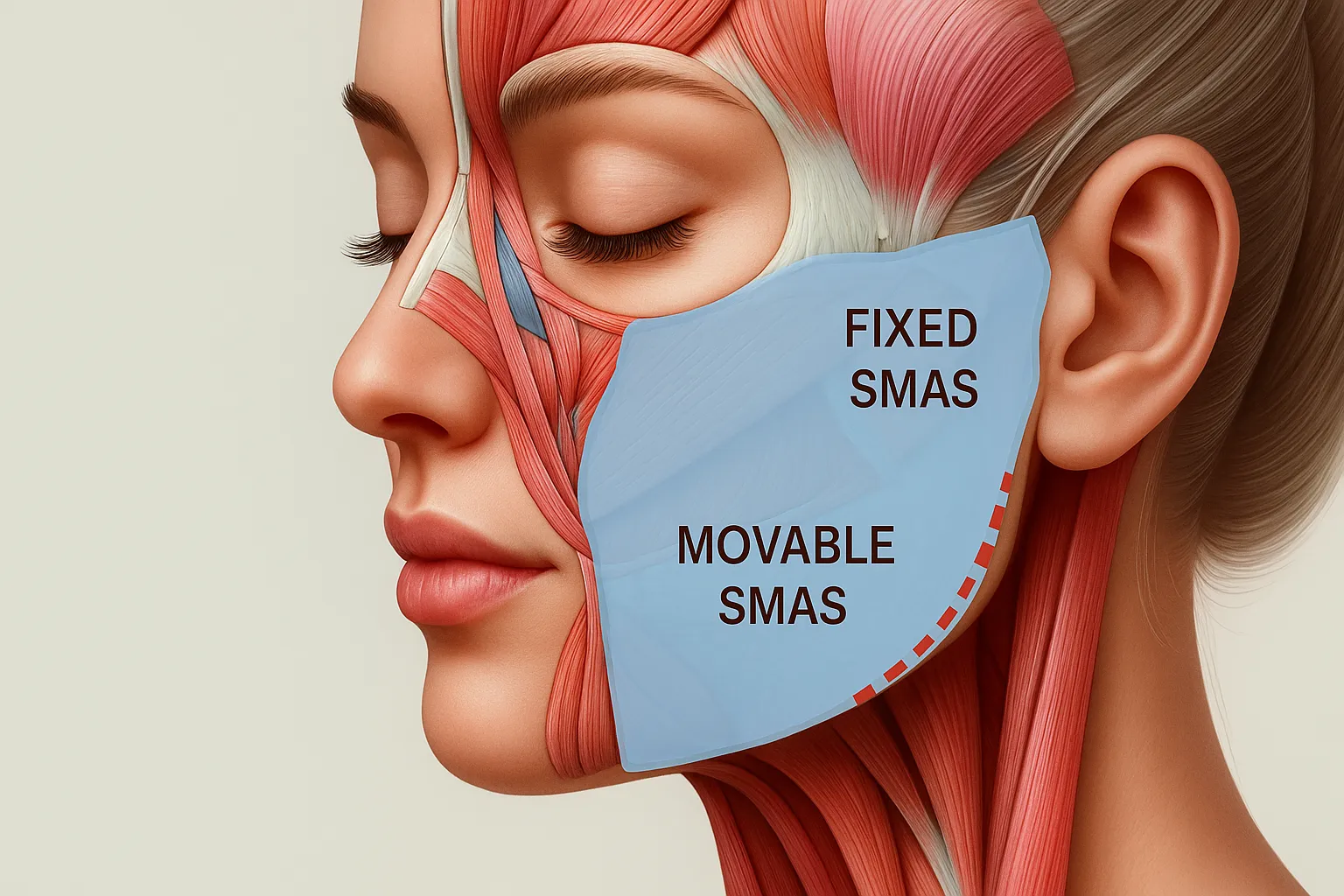
Just for clarity, the SMAS layer is where the real action happens—it’s the support system beneath your skin that changes with age. Loosening of the SMAS is the primary reason our faces start to look less youthful. If we don’t lift that SMAS back to its youthful position during a facelift, the surgery will be weak and ineffective. And, you run the risk of looking pulled and unnatural. By reshaping and resuspending the SMAS, we’re not just tightening what you see in the mirror; we’re anchoring your facelift to a deeper, stronger foundation. The result looks more natural and lasts much longer. No question addressing this foundational layer during a face or neck lift is the single most crucial step of the surgery.
All-Out Refresh vs. Subtle Tune-Up: Choosing a Full or Mini
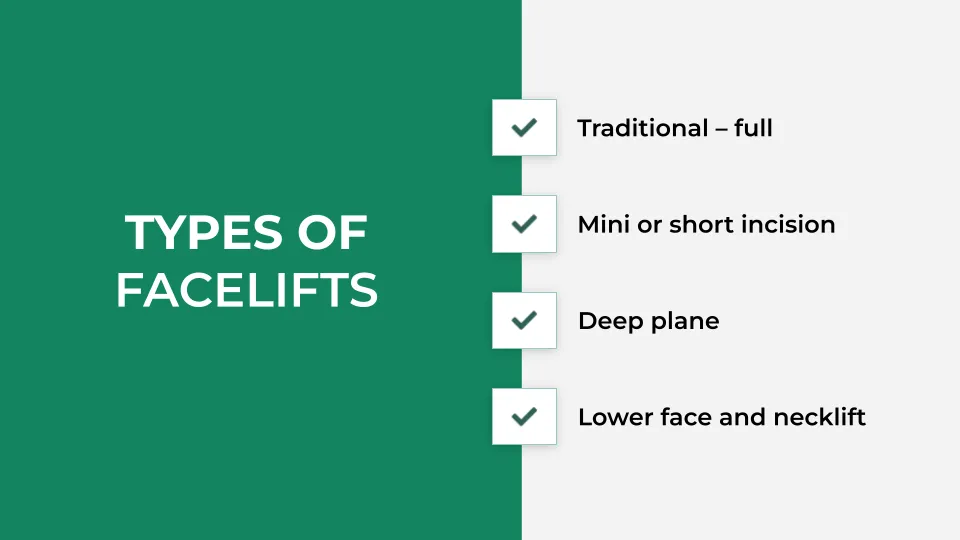
In our practice, we don’t just do a facelift — we do all the facelifts. Every type. Mini, short-incision, complete facelift with neck work, deep plane, SMAS…if it’s a proven technique, it’s on our menu. We choose the right approach (or combo) for your anatomy and goals, so the surgery is tailored to your face—not to a trend. Here is how we break it down:
-
Complete (traditional) facelift
This is the workhorse. A complete facelift addresses the mid and lower face and often the neck as well. Incisions are carefully placed around the ear and into the hairline to fully lift, tighten, and redrape the deeper structures and skin. It’s ideal when you’ve got more advanced jowling, neck laxity, or multiple areas aging at once and want a comprehensive, long-lasting result.
-
Mini / short-incision facelift
Think of this as the “early intervention” facelift. It’s great for patients with early jowling or mild lower-face laxity who don’t yet need the full-court press. Incisions are shorter, recovery is often quicker, and it can buy you 7-10 years before you ever need a more extensive lift—as long as your presentation and goals match with what this operation can realistically do.
Facelift in 60 seconds - YouTube
Same-Layer, Different Styles (Deep Plane vs SMAS layer approach)
SMASectomy, SMAS plication, and deep plane facelifts are all birds of the same feather — they just take slightly different routes to lift the deeper support layer of your face. Each technique tightens and repositions the foundational layer, the SMAS, to improve the appearance of your cheeks, your mouth, and your jawline. The differences are primarily in how we get there, not whether we actually reshape and resuspend this foundation. That’s why we are open-minded to every approach in our office. It is our goal always to pick the winning horse, so we choose the approach that best fits your anatomy, goals, and how you’ve aged.
-
Deep plane vs. SMAS approaches
This is where the alphabet soup really starts. These terms describe what we do with the foundation layer beneath the skin (the SMAS). In a deep-plane facelift, we elevate and reposition tissues in this layer, which can be especially helpful for specific age-related changes in the cheeks and midface. In SMAS-based facelifts, we tighten, fold (plicate), or reposition the SMAS itself, which works like a Swiss Army knife for most patients.
-
Here’s the key: current data in peer-reviewed journal articles show excellent, comparable outcomes when either approach is done thoughtfully by an experienced surgeon. The smarter question isn’t, “Is deep plane better?”—it’s, “Which approach is best for my specific anatomy and aging pattern?” And fyi, it could be a deep plane. Or maybe it isn’t. It just depends on your problem areas.
There’s no single “magic” facelift, the latest post, hashtag, or influencer claims notwithstanding. The real magic is in the surgeon’s judgment — someone who understands how you have changed with age. We are fluent in every facelift technique, and we mix and match approaches to create results that look natural to you, and just refreshed. If you’re curious what that might look like for your own face, we’d love to meet you—schedule a consultation, and let’s design a facelift plan that actually fits you.